A guide to bed flexibility
A Better Fit for Adjustable Beds: Flexibility, Layers, and Setup
An adjustable base changes more than your viewing angle. As the head and foot rise, the mattress must bend, settle, and return to level without its layers drifting or resisting the frame. The right pairing starts with a closer look at construction, dimensions, weight limits, and setup—not simply a mattress label that says “compatible.”
The bed moves; the whole sleep surface responds
An adjustable bed turns a familiar rectangle into a changing landscape. One moment the mattress lies flat; the next, its head section lifts for reading or its foot section elevates for rest. That movement can feel subtle, but it asks the mattress, its cover, and the base beneath it to work together through repeated bends.
This is why adjustable-base compatibility is best understood as a relationship, not a single product feature. A base may articulate correctly while a mattress feels stiff, bunches near a hinge, or shifts out of position. Conversely, a mattress that flexes readily may still be unsuitable if it exceeds the base’s stated weight capacity or dimensions.
Thinking through the complete setup helps avoid surprises. Consider the mattress’s internal layers, how those layers are secured, the frame’s bend points, the footprint of the base, and the instructions supplied by both manufacturers. The goal is a surface that moves smoothly while remaining supportive, stable, and properly aligned.
What flexibility means in a mattress
Flexibility is not simply softness. A plush mattress may compress under pressure without bending cleanly with an adjustable frame, while a more supportive construction may articulate smoothly because its materials and layers can follow the base’s contours. Flexibility describes how the complete mattress responds when it is lifted, not just how it feels when someone lies on it.
As the base changes shape, the mattress must curve at specific points. The head section rises around the upper body, while the foot section may elevate beneath the legs. Depending on the base design, these movements can place pressure on the mattress at hinge areas. A construction that accommodates those curves tends to feel more natural than one that resists movement or remains rigid.
Materials, layer thickness, quilting, and the way components are joined can all influence this response. No material category guarantees compatibility in every design. Instead, the exact construction matters: two mattresses made with latex, foam, or other materials may behave differently because their thickness, firmness, cover, and internal arrangement differ.
It is also useful to distinguish bending from collapsing. A mattress should follow the base rather than sag unpredictably between its sections. When raised, it should maintain a coherent sleep surface, with the comfort layers staying in place and the support structure continuing to do its job. Movement should feel deliberate, not like a pile of components slipping over one another.
Layers: the hidden architecture of comfort
A mattress is a system of layers, each contributing to the way the bed feels and moves. Comfort layers at the top soften the surface and cushion pressure points. Deeper support layers help carry body weight and maintain a stable foundation. Covers, quilting, and any internal fasteners add further structure. On an adjustable base, each of these parts must respond to bending without becoming uncomfortable or displaced.
Layered designs can be especially worth examining because a mattress’s ability to articulate depends partly on how its layers interact. Separately arranged layers may move in relation to one another, which can be helpful if the construction is designed for that movement. But if layers are not sufficiently contained, repeated raising and lowering could contribute to shifting, gaps, or bunching. A tightly secured construction may remain orderly, yet a rigidly assembled core or cover could resist a deep bend.
Neither “loose” nor “tightly secured” is automatically better. The relevant question is whether the manufacturer intends the mattress to be used on an adjustable base and has designed its construction accordingly. Look for specific instructions, not assumptions based on a mattress being made from a particular material or having a certain number of layers.
Latex is often discussed for its resilience and springy response, but a latex mattress still needs to be evaluated as a complete product. Thickness, firmness, layer arrangement, and its surrounding cover can change the way it bends. A customizable latex mattress, for example, may have distinct layers that need to be installed according to the maker’s guidance. Its adjustable-base suitability should be confirmed for the particular model and configuration.
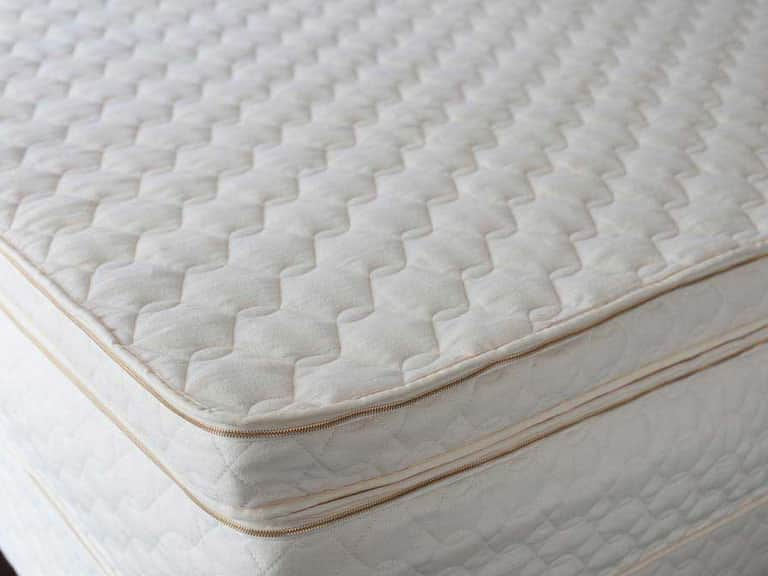
For a product-specific example, the Savvy Rest Serenity Latex Mattress is described as usable on an adjustable bed base. Its construction includes three latex layers within a zippered cotton casing with wool quilting, and its layer firmness can be customized. That information is useful as a starting point, but setup should still follow the current instructions for the mattress and the adjustable base being paired with it.
Why the same mattress may feel different when raised
When a mattress is flat, body weight is distributed across a broad, level surface. As the head rises, the angle changes how the body meets the bed and how the mattress bears pressure. The surface may feel firmer in one area or more supportive in another, even though the materials have not changed. When the foot section lifts, the bend can also alter how the mattress rests over the base.
The sensation may be most noticeable around the transition between moving sections. A mattress that is comfortable in a flat position may feel different when the base is elevated because the body’s posture changes and the mattress curves. This does not necessarily mean something is wrong; it does mean that comfort should be assessed in the positions the sleeper expects to use, not only with the bed completely flat.
Try adjustments gradually. Raise the head or foot section in small increments and pause to notice the support, pressure, and overall stability. If the mattress appears to resist movement, lifts away from the deck, or develops a pronounced fold, return the base to level and consult the manuals. A surface should not be forced into a position its makers do not recommend.
Start with the base: size and weight limits
Before pairing a mattress with an adjustable base, confirm that their dimensions match. The mattress should be made for the same bed size and should sit within the intended boundaries of the platform. A mattress that is too long, too short, or too wide can overhang, leave exposed sections, or interfere with movement. Even a small mismatch can become more evident when the frame bends.
Compare exact measurements rather than relying only on labels such as queen or king. Product dimensions can vary by manufacturer, and split configurations may have different requirements from a single-piece mattress. If the base uses two independently moving sides, confirm whether it requires one mattress per side or supports a continuous mattress across the full width. The relevant answer comes from the base’s documentation.
Next, check the base’s weight capacity. The stated limit may account for the mattress, sleepers, and other loads, but manufacturers define and present capacity differently. Read the product manual carefully to establish what is included. Do not assume that a frame rated for a certain load can safely accommodate a heavier mattress and two occupants simply because the mattress fits its surface.
Also consider the mattress’s own weight and the practical demands of installing or adjusting it. A heavy mattress can be difficult to reposition, particularly if it needs to be centered or reset after the base has moved. The base’s lifting mechanism must be appropriate for the combined load, and the bed should be assembled and used only within the limits specified by its maker.
Compatibility is more than a label
“Adjustable-base compatible” is an important phrase, but it should lead to a few follow-up questions. Does the statement apply to the complete mattress, including any topper or special cover? Are there restrictions on the angle or frequency of articulation? Does the manufacturer specify a particular style of base? Does the mattress warranty require certain foundation conditions?
These details can matter because the mattress and base are separate products, each with its own guidance. A mattress maker may approve use on adjustable bases generally, while a base maker may restrict mattress thickness, weight, or construction. Compatibility is strongest when both sets of instructions agree. If they appear to conflict, ask the manufacturers before setting up the bed.
Accessories should be considered too. A topper, mattress protector, or tightly fitted sheet adds another layer to the system. Most bedding is intended to flex with the mattress, but a cover that is too tight can pull at the corners or constrain movement. A topper may shift during articulation if it is not designed to stay in place. Check its instructions and make sure the fitted sheet has enough depth to accommodate the total mattress height without pulling the surface taut.
Where a mattress uses movable internal components, take special care to follow assembly and positioning instructions. Some designs allow the owner to arrange or replace layers, while others are intended to remain in a set configuration. Do not assume that rearranging a mattress to make it bend more easily is appropriate; changing the construction may affect support, performance, or warranty terms.
A considered setup, step by step
Preparation makes installation calmer and helps protect the bed’s construction. Before lifting the mattress, clear the surrounding area and make sure the floor can support the base. Keep hands and loose objects away from hinges and moving joints. If the mattress is bulky or difficult to handle, use the assistance recommended by the manufacturer rather than trying to maneuver it alone.
- Read both manuals. Confirm mattress compatibility, base limits, assembly requirements, and any restrictions on use.
- Verify dimensions. Match the mattress size to the base and check the exact measurements where a split or specialty configuration is involved.
- Check the total load. Include the mattress and expected occupants when interpreting the base’s weight limit, following the maker’s definition.
- Assemble the base on a stable surface. Follow the supplied sequence and ensure the frame is level, secure, and free of obstructions before adding the mattress.
- Position the mattress carefully. Center it on the platform and align its edges with the base’s intended support area.
- Add bedding without tension. Fit sheets and protectors securely but avoid stretching them so tightly that they pull at the mattress as the base moves.
- Test movement slowly. Operate the base through its intended positions while observing how the mattress follows each bend.
After the first movement test, lower the base to flat and check that the mattress remains centered. Look along the edges and across the surface for signs of bunching, a shifted topper, or a loose component. If anything appears out of place, stop and consult the relevant instructions before continuing.
Watch for shifting, bunching, and strain
Small movements are not always a cause for concern, but repeated or pronounced displacement deserves attention. A mattress can slide if the platform is slick, if the fit is incorrect, or if the base moves in a way the construction is not designed to follow. Some bases include features intended to help keep a mattress in position; use only the restraints or accessories supplied or approved by the manufacturer.
Bunching may appear as a ridge or fold, often near a bend point, or as fabric gathering at the surface. It can result from a cover that is too tight, layers that have migrated, a topper that lacks secure placement, or a construction that does not articulate smoothly. Lower the bed and inspect the setup. Avoid pulling aggressively on the fabric or forcing the base through repeated cycles to “work out” the problem.
Also listen and observe as the frame moves. Unusual noise, uneven lifting, or a mattress that separates noticeably from the platform may signal that something is obstructed, overloaded, misaligned, or incompatible. Stop operation if the base seems strained. Check for items beneath or around the frame, verify assembly, and contact the manufacturer if the issue continues.
Regular, simple checks are worthwhile, especially after moving the bed or changing its bedding. Confirm that the mattress is still centered, the power cord remains clear of moving parts, and the base has room to articulate. A tidy setup is not merely aesthetic; it helps protect the mechanism and keeps movement unobstructed.
The foundation beneath the base
An adjustable base needs a suitable support surface of its own. Some models are designed to stand on legs, while others may be placed within a compatible frame or on a platform. The exact arrangement depends on the base. Do not place an adjustable frame on a foundation, slat system, or furniture structure unless its instructions explicitly allow that configuration.
Check the floor and surrounding furniture for adequate clearance. The base may move downward or outward as it articulates, so drawers, bedside cabinets, rugs, and stored items should not obstruct its path. If the bed is installed inside a frame, verify that the frame leaves enough room for the base to move freely and that the base remains stable in its intended position.
Electrical setup deserves the same care. Follow the manufacturer’s instructions for outlet use and cord routing, keeping cables away from hinges, lift mechanisms, and areas where they could be pinched. Avoid improvising extensions or connections that the manual does not permit. If the base is hard to reach after installation, plan the cable route before placing the mattress.
How to assess comfort in real life
A well-matched setup should feel secure in both flat and elevated positions. Test the positions you are likely to use—perhaps a gentle incline for reading or a modest lift beneath the legs—and pay attention to whether the mattress stays composed. The objective is not to achieve the most dramatic angle, but to find positions that feel comfortable while remaining within the base’s operating instructions.
Notice how your body is supported as the surface changes. Is the head section comfortable without an abrupt fold? Does the mattress remain stable under the hips and shoulders? Does the edge stay where expected? Responses differ by sleeper, mattress, and base, so a short, considered trial is more informative than a blanket claim that one material or firmness works for everyone.
If two people share a bed, consider how each person uses the adjustable features. A split base may allow independent movement, but the mattress arrangement must be designed for that configuration. Confirm whether the system uses separate mattresses, a shared mattress, or a connector, and follow the base maker’s directions. A configuration that suits one sleeper’s movement may not be right for another.
Give the setup time, but do not ignore persistent discomfort or mechanical concerns. If the surface feels markedly different when raised, test a smaller adjustment and verify that the mattress and base are matched as intended. If there is ongoing shifting, excessive bunching, or difficulty operating the frame, seek guidance from the manufacturer rather than making unapproved modifications.
Care that preserves the partnership
Keeping a mattress on an adjustable base in good condition is largely a matter of following care instructions and avoiding unnecessary strain. Rotate or reposition a mattress only if its maker recommends doing so, and check whether the design has a designated top and bottom. A mattress that is not reversible should not be flipped, and a layered model may have specific directions for maintaining its configuration.
When changing bedding or cleaning beneath the bed, return the base to a level position first. If the frame must be moved, follow the manufacturer’s safety guidance and avoid lifting it by a motor, hinge, or other component not intended to bear weight. After any move, inspect the base, cords, mattress alignment, and surrounding clearance before operating it again.
Finally, retain the manuals and warranty information. They provide the definitive details for load limits, compatible mattress construction, assembly, care, and service. A brief check of the documentation at the start can prevent guesswork later—and is particularly valuable when a mattress has adjustable layers, a nonstandard height, or a distinctive cover construction.
The essentials to remember
Choosing a mattress for an adjustable bed is an exercise in looking beneath the surface. Flexibility depends on the complete construction: comfort and support layers, how components are held together, the cover, and the way the mattress’s dimensions relate to the frame. A material name alone cannot answer whether a particular model will bend comfortably or remain stable.
Confirm the base’s size and weight limits, check compatibility with the exact mattress configuration, and follow both manufacturers’ setup guidance. Once assembled, move the bed gradually and watch for shifting, bunching, strain, or obstruction. A mattress that follows the frame smoothly, stays centered, and supports the body in the positions actually used is the better fit—not because it has the most elaborate feature list, but because its construction and setup work in harmony.
Adjustable beds can make a sleep space more adaptable, but the elegance of the experience lies in the details: a measured bend, a stable layer, a clean fit, and a base that moves without resistance. Make those checks before settling in, and the transformation from flat mattress to tailored comfort feels less like a mechanical trick and more like a considered part of the room.